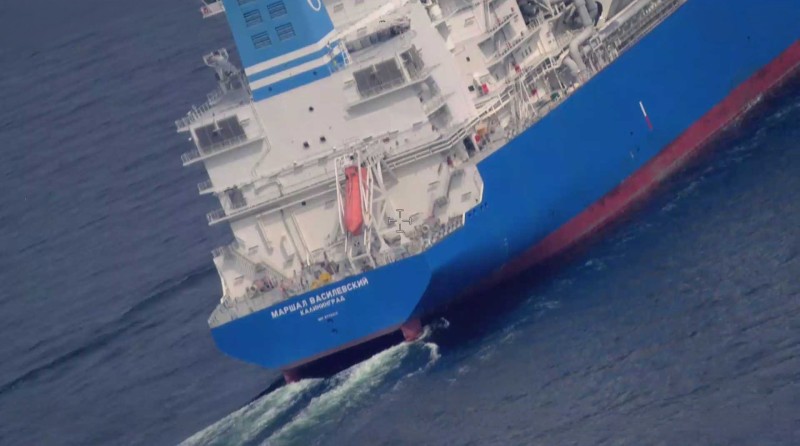
New surveillance images show that Moscow has mounted heavy machine guns on a civilian gas tanker that runs vital energy supplies to its Baltic exclave of Kaliningrad. The photographs, captured in May, reveal sandbagged firing positions on either side of the bridge of the Marshal Vasilevskiy, a vessel owned by Russian state energy giant Gazprom.
The images, obtained by Estonian border guards, clearly show 12.7-millimeter Kord heavy machine guns behind the defensive ramparts. These weapons, introduced in Russia in the late 1990s, remain lethal from distances of up to two kilometers. The armed vessel was observed sailing within 13 nautical miles of the Estonian shoreline during its regular transit.
Beyond the visible armament, passenger records obtained by analysts indicate that more than 20 individuals aboard the ship have ties to Russian military or intelligence structures, including the FSB. One passenger reportedly listed a residence at an FSB base near Moscow and has been on board for the last four journeys from mainland Russia to the exclave.
Security experts assess the arming is a dual-purpose move. One senior European intelligence official described the measure as 50 percent defensive—aimed at deterring potential Ukrainian drone attacks—and 50 percent symbolic, meant to send a warning to Western navies. Analysts suggest that if word spreads that heavy machine guns are present on such vessels, the risk assessment for any boarding operation changes fundamentally, making intervention far less likely.
The Marshal Vasilevskiy is not part of the so-called “shadow fleet” of aging, opaque tankers that evade sanctions. Instead, it plies a defined route between two Russian ports, carrying liquefied natural gas and converting it back to a gaseous state upon arrival in Kaliningrad. That exclave, wedged between NATO members Lithuania and Poland, relies heavily on this energy lifeline, which also powers Russian military forces stationed there.
Estonian naval and border officials have warned that the presence of such weapons on a civilian tanker escalates risks in the already tense Baltic region. A Danish naval commander noted that if NATO forces were to approach the ship, they might face fire, calling the situation “quite dangerous.” A senior Estonian border guard remarked that he had never seen such a modification on a Russian civilian vessel. Gazprom did not respond to requests for comment.