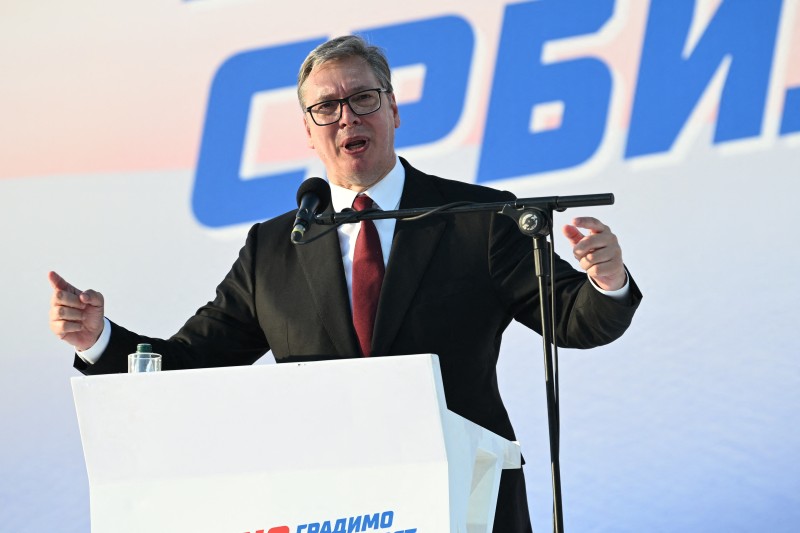
Serbian President Aleksandar Vučić has downplayed reports that the ex-leader of the nation’s football federation orchestrated plans to intimidate former Manchester United defender Nemanja Vidić, even as authorities announce steps to investigate the matter.
The controversy erupted after an investigation published last week revealed encrypted messages allegedly showing Slaviša Kokeza, the former president of the Football Association of Serbia, discussing the hiring of criminals in 2020 to track and assault Vidić. The football icon had publicly criticized the association’s performance.
The leaked communications, obtained from the encrypted Sky ECC platform, also indicated Kokeza intended to target other players—Nemanja Matić, Danko Lazović, and Dragan Mrđa—for supporting Vidić. Additionally, the messages showed efforts to cultivate support from influential Red Star Belgrade ultras and suggested ties to the reputed criminal Veljko Belivuk.
Following the publication, Serbia’s Organized Crime Prosecution acknowledged it had been unaware of the communications but now plans to act. The office stated it will request records from the Interior Ministry to determine whether authorities possessed the intercepted chats and what actions, if any, were taken.
The prosecution noted that Europol typically shares Sky ECC intercepts only with the Interior Ministry, meaning prosecutors can only review materials forwarded by police. The ministry has yet to comment on whether it holds the messages.
The case gained further traction when attorney Ivan Ninić filed a criminal complaint against Kokeza, alleging preparation of murder for personal gain. The complaint also accuses unidentified police officers of covering up the plot when Kokeza was questioned in early 2021, allegedly ignoring evidence that Vidić faced danger and allowing the former football official to leave the country freely. Ninić is seeking an international arrest warrant and an internal police investigation.
The Higher Public Prosecution in Belgrade, which received the complaint, said it will forward the case to the Organized Crime Prosecutor due to jurisdictional issues.
Despite the escalating legal actions, President Vučić dismissed the revelations in a televised interview, stating, “Neither Nemanja Vidić is particularly important to me, nor is Slaviša Kokeza particularly important to me.” He rejected claims that his brother Andrej had backed Vidić, describing him as “not exactly a big fan” of the footballer.
Vučić also minimized his connections to football hooligans mentioned in the messages, acknowledging he has known Stevan Sojić, a reputed hooligan, for over three decades but insisting their discussions were limited to “nonsense about who unfurled a bigger flag or who kicked the ball better.”
However, others reacted with alarm. Former national team coach Slavoljub Muslin expressed shock, telling a daily newspaper, “It is terrifying when the head of the football association wants to endanger Vidić or his family over a statement that was purely sports-related.” Muslin doubted Kokeza would face consequences under the current administration, adding, “With this government, there is neither justice nor the rule of law.”