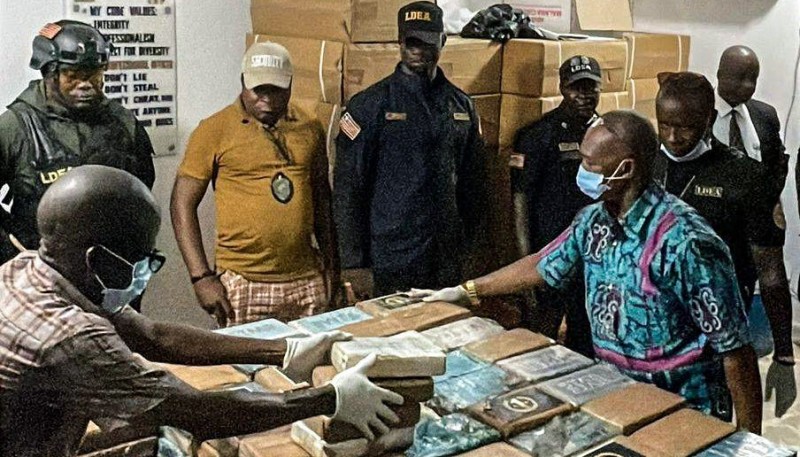
Amid rising public frustration over the stalled investigation into a massive cocaine seizure at Liberia’s main airport, senior police officials faced a heated grilling in the Senate on Wednesday, urging patience and vowing that arrests are imminent.
“We will make arrests. We have elevated people from persons of interest to suspects, and we will make arrests in the coming days,” said Gregory Coleman, Inspector General of the Liberia National Police, addressing the full Senate plenary.
The special public hearing was convened as scrutiny mounted over the seizure of 237.6 kilograms of cocaine at Roberts International Airport last month. The Liberia Drug Enforcement Agency (LDEA) had initially celebrated the June 8 confiscation—valued at roughly $19 million—as a key victory against international drug trafficking.
“We are sending a clear message to international cartels: Liberia will not be a playground for your illicit trade. Our borders are being watched 24/7,” LDEA Director General Fitzgerald T.M. Biago declared at the time.
But nearly a month after agents found 198 compressed plates of cocaine hidden in six plastic cargo boxes destined for export on a Brussels Airlines flight, law enforcement has faced harsh criticism for a lack of visible progress. No official updates have been released, while leaked details to traditional and social media have fueled widespread suspicions of a cover-up.
“Shielding drug traffickers is one of the major problems facing our country. We urge the Liberia Drug Enforcement Agency and the Liberia National Police not to protect anyone caught trafficking drugs,” said Rev. Kortu Brown, former president of the Liberian Council of Churches, in an interview this week.
The United Nations Office on Drugs and Crime notes that West Africa’s coast, including Liberia, is a key transit zone for cocaine moving from South America to European markets.
The Senate hearings were prompted by a letter from Senators Amara Konneh and Edwin Melvin Snowe, who criticized the investigation for being “unacceptably slow.”
“To date, there has been limited official communication on the status of the investigation, no publicly known arrests of principal suspects, and an unsettling silence from key national security and law enforcement institutions,” they wrote.
Last week, President Joseph Boakai responded to the outcry by forming a Joint National Security Investigative Task Force to probe how the cocaine passed security and moved through the airport’s cargo system. The Ministry of Justice has since named at least 10 persons of interest, including a logistics company CEO, an airport intelligence officer, and several security staff.
One of them, Paul J. King, general manager of GLS Menzies handling service—which operates the warehouse where the cocaine was intercepted—has denied involvement and requested witness protection after surrendering to the task force. King allegedly told investigators that a man named Rahim Bah was the shipper of the packages.
However, phone records reviewed by investigators showed that the number King attributed to Bah is registered to a former Roberts International Airport communications staffer who was fired and arrested in 2024 for allegedly trying to traffic over $1 million worth of methamphetamine on a Brussels Airlines flight.
Concerns have grown that this former staffer, along with another individual captured on CCTV conducting a bank transaction linked to the drug shipment, have not been named as persons of interest.
In his Senate testimony, the police inspector general stated that “there is a massive manhunt on” for the former airport employee, who is “currently at large.”