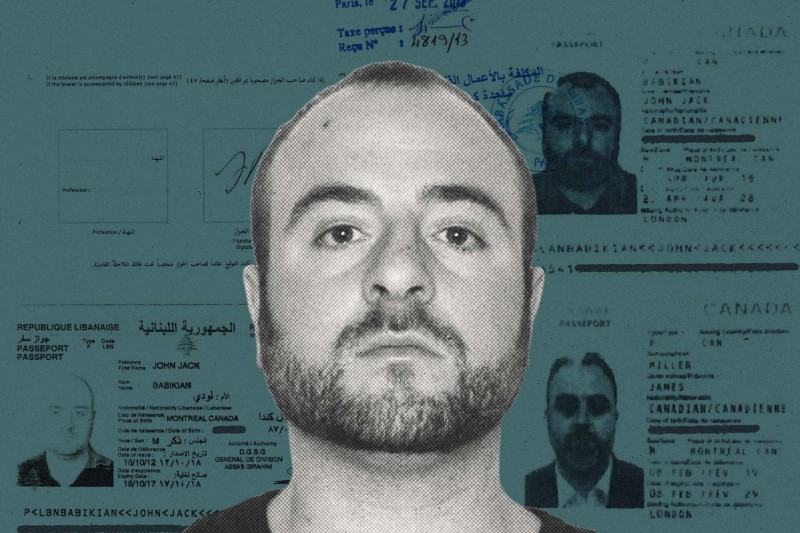
A former Canadian stock promoter, once labeled the “Wolf of Montreal” for his penny-stock schemes, quietly reinvented himself abroad—securing a new identity, residency in Latvia, and a multimillion-dollar apartment in Dubai, according to newly uncovered documents.
The man, originally known as John Babikian, vanished from public view after reaching a $3.7 million settlement with U.S. regulators in 2014 over allegations of securities fraud. That deal, which allowed him to neither admit nor deny wrongdoing, resolved a case centered on a tactic known as “scalping”—buying cheap stocks, pumping them up online, and quickly selling them for profit.
By the time he settled with the Securities and Exchange Commission, Babikian had already left Canada, where authorities claimed he owed roughly $14 million in unpaid taxes. Investigators later traced his movements through Lebanon, Latvia, and the United Arab Emirates.
Records show Babikian legally changed his name to James Miller in 2019, obtaining a Canadian passport under that alias. A Latvian residence permit was also issued in his new name, while leaked property data from a global investigation revealed he purchased a $4.6 million apartment on Dubai’s Palm Jumeirah—a luxury archipelago—in 2022.
Babikian did not respond to requests for comment. His former lawyer said the firm had not been in contact with him for years.
The name change came to light through court files connected to an Austrian intelligence officer, Martin Weiss, who is under investigation for alleged espionage. During questioning, Weiss confirmed he had received copies of Babikian’s passports to assist with a Hungarian citizenship application—though it remains unclear if that application succeeded.
Beyond his recent real estate deal, Babikian’s past financial maneuvers were staggering. According to Canadian tax records, he dramatically underreported his income between 2008 and 2012, failing to declare over $44 million in earnings to the Canada Revenue Agency. In 2011 alone, he reported no income despite making $8.2 million. His alleged 2012 earnings soared to nearly $20 million, fueled by a single 90-minute stock promotion that netted $1.9 million.
His scheme drew comparisons to the classic “boiler room” operations of the 1980s—but Babikian worked in the digital age. The SEC alleged he sent promotional emails to 700,000 people in February 2012, causing shares in a coal company to jump from 29 cents to $1.80. The emails failed to disclose that Babikian owned 1.4 million shares, which he dumped once the price surged.
Despite settling with the SEC, Babikian’s legal troubles continued. In 2023, an Oregon jury ordered him to pay $23.4 million over a failed vineyard deal. A court filing showed he sought to testify remotely from Lebanon, citing illness. The judgment awarded full ownership of the vineyard to the plaintiff, and Babikian forfeited his 50% stake rather than pay the fine.
Efforts to scrub his online reputation also emerged. One Oregon news outlet received an email from a representative demanding removal of a 2014 article about the vineyard dispute, claiming it contained baseless allegations—this despite Babikian’s own SEC settlement. Investigators found a pattern of digital identity manipulation, including fake profiles on social media and fraudulent articles that spread the false claim that Babikian was acquitted in the SEC case.
When searched online, a fabricated John Babikian appears—described as a Harvard-educated Rwandan lawyer with a quote supposedly from famed attorney Alan Dershowitz. Dershowitz confirmed to reporters that the quote was fake. Photo analysis suggests the accompanying headshot was likely generated or manipulated using artificial intelligence.
Tax authorities in Quebec managed to seize some of Babikian’s assets, including bronze and silver bull sculptures and 500 bottles of wine valued at hundreds of thousands of dollars. However, they failed to recover his Bugatti Veyron, a luxury car worth over $1 million.
As of now, Canadian tax officials declined to say whether Babikian’s debt—accruing interest daily since 2014—remains active.