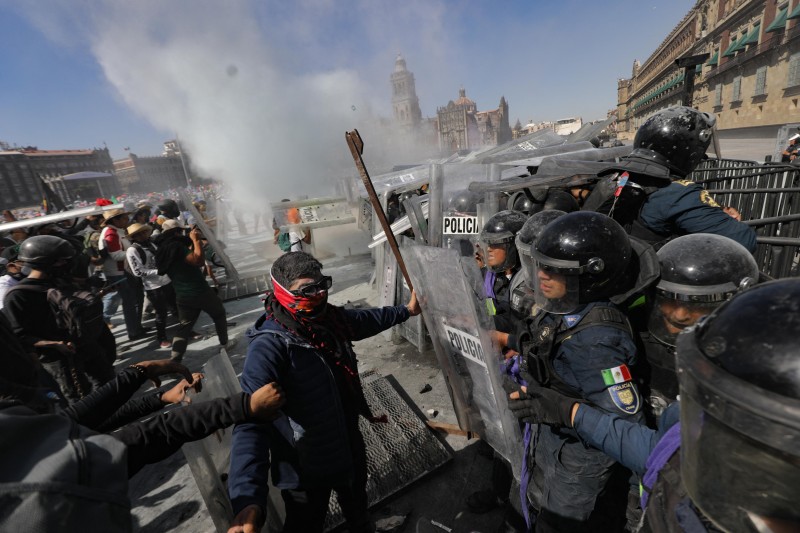
Thousands of demonstrators filled Mexico City’s streets on Saturday, voicing outrage over escalating cartel violence and government graft, amid a nationwide wave of unrest that extended to 50 cities in 30 states.
The protests were sparked by the brutal slaying of Uruapan Mayor Carlos Manzo on November 1, during a Día de los Muertos celebration. Manzo, a fierce opponent of organized crime, was killed by a teenage assailant allegedly connected to the Jalisco New Generation Cartel. He had repeatedly asked federal and state authorities for protection before his death.
Protesters donned wide-brimmed hats and waved signs demanding justice for the fallen mayor. What began as a peaceful assembly near the Zócalo soon descended into chaos when confrontations erupted with security forces. Mexico City security chief Pablo Vázquez reported 120 injuries and 20 arrests, noting that most of the hurt were police officers, with 40 requiring hospital care.
According to witness accounts, clashes intensified near the National Palace, where riot barriers were toppled. Vázquez alleged that the unrest was instigated by masked individuals who “threw explosive devices” at officers, prompting a heavier security presence.
President Claudia Sheinbaum downplayed the turnout at a Saturday event in Tabasco, asserting that “very few young people” participated and accusing some of “violently removing barriers and breaking windows.” She emphasized, “We reject violence.”
The conservative National Action Party condemned what it termed “the state’s aggressive reaction to peaceful youth.” Meanwhile, Mexico’s Supreme Court criticized both the attacks on police and “efforts at unauthorized entry into the government building.”
This wave of protest is part of a broader global movement, with youth-led anti-corruption demonstrations having erupted since August in Indonesia and Nepal, then spreading to the Philippines, Morocco, Madagascar, Togo, and Peru. Although branded as a “Gen Z” phenomenon, Mexico’s gatherings drew participants of all ages.