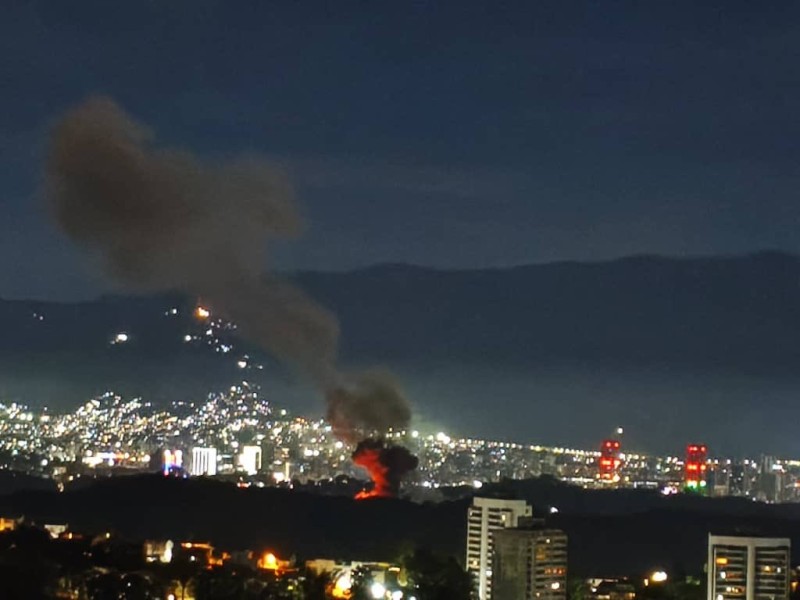
Millions of mobile devices across Venezuela and the global diaspora lit up overnight, transmitting frantic messages, live updates, and conflicting rumors as U.S. military forces bombed targets in Caracas and captured President Nicolás Maduro.
At 2:10 a.m., just hours after New Year’s celebrations, a WhatsApp group connecting Venezuelans at home and abroad received an urgent alert.
“Friends. Urgent. They are attacking. Planes are flying over.”
Within a minute, a reply came: “Explosions.”
The broadcast had begun.
Parts of the capital went dark, then flickered as explosions briefly illuminated the skyline. Residents leaned from windows and balconies, straining to grasp the scope of the assault as the unfamiliar roar of military aircraft tore through the night.
Messages multiplied and ricocheted across digital networks that had long carried news of Venezuela’s crises—corruption, hyperinflation, shortages, arrests, and mass exodus. This time, the information traveled even faster, leaping from Caracas to Miami, Madrid, Bogotá, and Buenos Aires, wherever the 7.7 million Venezuelans who have fled since 2014 now live—roughly one-fifth of the population.
“They’ve been attacking for about 40 minutes,” one message stated. “But not continuously. There are pauses. The first blast was enormous. Now they’re smaller. I’m shaking with fear.”
No one knew precisely where the strikes were hitting. Early reports—a mix of rumor and eyewitness accounts—mentioned military installations scattered across the city. The uncertainty proved as unsettling as the noise.
Then, around 5:30 a.m., the U.S. president delivered the real shock.
“They captured Maduro and took him out of the country. Trump says.”
“Where does it say that?” someone demanded.
Trump announced that Maduro, along with his wife, Cilia Flores, had been arrested following what he called a “large-scale” military operation. Attorney General Pam Bondi followed, declaring the couple would soon face “the full wrath of American justice on American soil in American courts.”
Maduro had been indicted in New York in 2020 on charges of “narco-terrorism conspiracy,” accused of colluding with Colombian guerrillas to traffic cocaine into the United States. He had long dismissed the case as political theater. But two senior Venezuelan generals later pleaded guilty to related charges, and a superseding indictment unsealed after his arrest expanded the alleged conspiracy to include his wife, his son, and the leader of the Tren de Aragua gang.
Prosecutors claim the suspects played distinct but coordinated roles in a narco-terrorism network spanning more than 25 years. Maduro allegedly used state institutions to facilitate drug trafficking, sold diplomatic passports to traffickers, and shielded planes carrying shipments, while his wife acted as the network’s financial broker and enforcer, relying on pro-government armed groups to protect operations and silence threats. The Venezuelan government has called the charges politically motivated.
The capture capped months of escalating pressure. Since September, the U.S. had widened sanctions and built up its military presence in the Caribbean, conducting operations that included bombing speedboats suspected of drug trafficking and detaining ships carrying Venezuelan oil. Speculation about an imminent intervention had become a constant hum.
As dawn broke, fresh waves of messages swept through WhatsApp groups. Some tried to process what they had just witnessed: explosions that briefly lit apartments, shattered windows in nearby buildings, streets left eerily empty, columns of fire and smoke rising into the sky. Others described long lines forming at grocery stores—a reflex honed by years of crisis.
“Caracas is absolutely silent,” one message read. “In the distance, you can hear gunshots.”
In some chats, the mood turned celebratory.
“I’ve been waiting for this news for 27 years,” someone wrote, counting the combined rule of Maduro and his predecessor Hugo Chávez. Later that day, Venezuelans in Colombia, Peru, Argentina, the United States, and Spain would take to the streets to celebrate. In one of the first videos posted that night showing a bomb exploding, a male voice can be heard screaming, “The gringos have arrived!”
But there were also denunciations of violated sovereignty and warnings of chaos. Still, shock—and, for many, grim satisfaction—dominated the exchanges. For a leader accused of ruling through force, corruption, and fear, the manner of his removal felt like poetic justice.
The Maduro government’s response arrived quickly on social media. Officials condemned the attack as foreign aggression and called on citizens and the armed forces to mobilize. Regional reactions followed: Brazil, Mexico, Colombia, and Chile questioned the operation’s legality, while Argentina voiced support.
Soon after, images appeared—photographs released by the U.S. government that seemed almost surreal. Maduro, escorted by DEA agents. Maduro, alone and masked, standing on a military vessel bound for the United States.
At a press conference later that morning, President Trump said the U.S. would “run” Venezuela until a “proper transition can take place.”
In one WhatsApp group, amid the flood of messages and unanswered questions, someone posted an uneasy emoji as if to ask: Hmm. What does that mean?