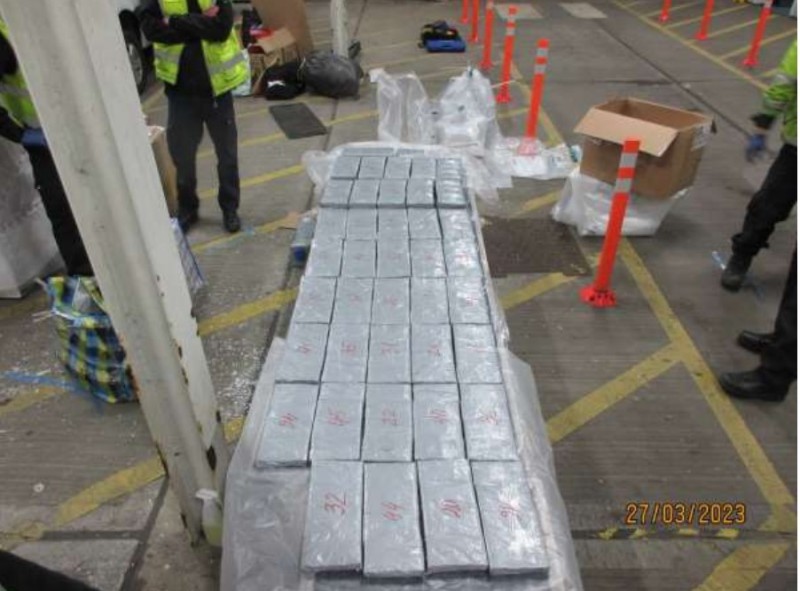
British authorities have described the bust as the largest money laundering operation they have dismantled in a decade. An international network, operating from Moscow and Dubai, has been funneling billions of dollars worth of cryptocurrency and cash for criminal activities, ranging from Russian ransomware attacks to street-level drug sales in the United Kingdom, according to law enforcement officials.
On Wednesday, the U.S. imposed sanctions on several key figures allegedly involved in the scheme, which authorities said has strong connections to the Russian financial sector. Among those targeted were George Rossi, the Russian-born Ukrainian founder of the TGR group of companies, and Ekaterina Zhdanova, a Russian national who leads another group called Smart. Zhdanova was already under U.S. sanctions from last year.
The National Crime Agency stated that Smart and TGR specialized in converting large amounts of illicit cryptocurrency, obtained by Russian ransomware groups, into cash. They did this by exchanging it with other criminal organizations that needed to launder their illegal profits into the legitimate financial system.
Ransomware groups reportedly extorted at least $34 million from 149 victims in the U.K., including hospitals, schools, businesses, and local authorities.
The cash-for-crypto exchanges allegedly involved groups like the Irish Kinahan gang, which was sanctioned by the U.S. in April 2022 for trafficking drugs and firearms into the U.K. and globally.
The crackdown, named Operation Destabilise, has been ongoing since 2021. It led to the arrest of 84 individuals connected to what the NCA called a “new generation laundromat.” The operation involved law enforcement from the U.K., Ireland, the U.S., and France.
“This operation has uncovered billion-dollar money laundering networks operating in ways previously unknown to international law enforcement or regulators,” said Rob Jones, the NCA’s Director General of Operations.
Both TGR and Smart operated from the Federation Tower in Moscow, a building that the NCA described as fortified against missiles and explosions. The building has housed over a dozen companies specializing in converting cryptocurrency to cash.
The investigation began in November 2021 with the arrest of Fawad Saiedi, who was caught transporting $335,000 in cash north of London. Authorities determined he was a “collector,” gathering cash from drug dealers and passing it up the laundering chain. Saiedi pleaded guilty to possession and transfer of criminal property, receiving a sentence of four years and four months in prison.
Investigators then targeted the Russian nationals coordinating cash-for-crypto swaps across the U.K. and Europe, according to Will Lyne, the NCA’s Head of Cyber Intelligence. In September 2023, they arrested Andrii Dzektsa, 28, and Semen Kuksov, 24, the son of a Russian oil executive. These two individuals ultimately reported to Ekaterina Zhdanova.
Zhdanova, 38, had been sanctioned a year earlier for laundering and moving funds via virtual currency for Russian elites and a ransomware group named Ryuk. Around that time, she was reportedly arrested in France as part of a separate money laundering probe.
Rossi’s group allegedly helped Zhdanova’s network move criminal cash out of the U.K. through traditional banking systems to Russia using shell companies linked to TGR, Lyne said. The location of Rossi, 49, remains unknown.
While some alleged members of the ring, including Zhdanova, have been arrested, police have only now revealed the full scale of the operation and its mechanics.
The network almost exclusively used Tether, a cryptocurrency designed to maintain a fixed exchange rate with the dollar, replacing Bitcoin as the favored digital currency for illicit transactions. This choice was seen as less volatile for those involved.
After exchanging their cash for Tether, gangs in the U.K. used it to pay for cocaine imports arriving in multi-ton shipments from South America, said Jones.
The Smart network was also used to fund Russian espionage operations from late 2022 to summer 2023, according to the NCA, though no specifics were provided.