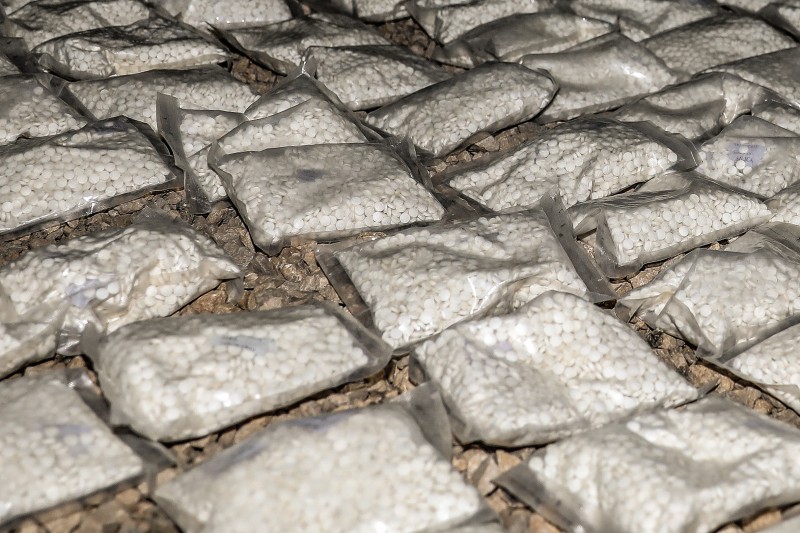
Authorities in Yemen have intercepted a massive shipment of 1.5 million Captagon pills concealed atop a refrigerated truck traveling from the Houthi-controlled capital, Sanaa, toward Saudi Arabia. This seizure, disclosed by the Yemeni Interior Ministry, marks a significant development in the regional drug trade and points to deepening involvement by the Houthi militia in narcotics smuggling to sustain their military campaigns.
The ministry’s statement indicated that the driver confessed the drugs belonged to dealers in Sanaa. Officials suspect the operation is linked to the Iran-aligned Houthi movement, revealing what they describe as extensive production and smuggling networks operating within areas under their control. Brigadier General Abdullah Lahmadi, head of the ministry’s drug control division, highlighted that this discovery illustrates the extent of trafficking allegedly backed by the group.
Information Minister Muammar al-Eryani of the internationally recognized government noted that the attempted shipment occurred at a critical juncture following the fall of the Assad regime in Syria, which had long been the primary conduit for Captagon to Gulf nations. He asserted that the Houthis have seized the opportunity to fill the void, intensifying their illicit activities and turning Yemen into a fresh launching pad for drug smuggling, thereby escalating security threats across the region.
Abdulhamid Amer, director of the National Center for Strategic Studies, reinforced these claims, stating that the Houthis heavily depend on drug revenues to fund their ongoing conflicts. A 2024 United Nations report on Yemen also accused the group of generating substantial illegal resources through trafficking in drugs, weapons, and telecom equipment.
Amer observed a rise in smuggling toward Saudi Arabia and the Gulf following the Assad regime’s collapse and the weakening of Hezbollah in Syria, both previously implicated in Captagon trade. He cited increased land and maritime trafficking, larger drug volumes, and growing domestic abuse, especially among youth, as signs of this shift.
While the legitimate government blames the Houthis, the group’s authorities have pointed fingers at Saudi Arabia. In 2021, a Houthi spokesman alleged that Riyadh orchestrated large-scale drug smuggling, claiming it freed 3,000 Yemeni prisoners on condition they engage in trafficking within the country.
In Syria, the interim government claims to be combatting the Captagon trade, with reports of shutting down production facilities and intercepting smaller shipments. However, analysts caution that technical expertise for producing the drug remains intact and smuggling networks persist, albeit at a reduced scale due to dwindling stockpiles.
A 2024 study by the UN Office on Drugs and Crime found that 82% of Captagon seized in the Middle East in recent years originated from Syria, with 17% from Lebanon. Despite record seizures across the Arab region, the drug continues to flow through evolving routes, now increasingly linked to Yemen.