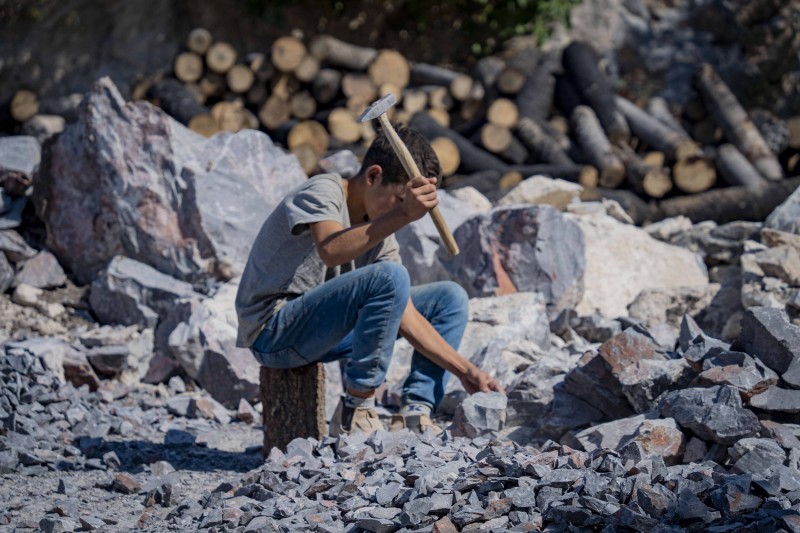
In the northern region of Paraguay, near the Brazilian border, children as young as 11 work alongside their families in state-owned limestone quarries. These young miners break apart massive stones with hammers, feeding fragments into kilns that produce quicklime, a vital component for cement. Though the work is illegal for anyone under 14 in hazardous conditions, the practice is widespread in the town of Vallemi, where generations have depended on the quarries for survival.
The National Cement Industry (INC), one of Paraguay’s largest state companies, owns these quarries but has no direct oversight of the workers. Miners are considered freelancers, operating outside formal labor protections. They lack medical insurance, social security, and legal safeguards, despite spending up to ten hours a day, six days a week, in dangerous conditions. Many resort to wrapping rags around their faces to block the thick limestone dust, a poor substitute for expensive masks. Respiratory diseases are common, and accidents frequent, but the nearest hospital is 160 kilometers away.
A 2014 agreement with INC formalized the miners’ role in exchange for a fee of about $1 per ton of stone extracted. However, this arrangement places them in a legal gray zone. INC subcontracted a local quarrymaster, who is technically responsible for safety, but this does little to improve conditions. Edson Ramirez, a kiln owner, explains that families rely on their children’s labor to afford basic necessities like food and school supplies. “If these children don’t work, they can’t eat or buy a notebook,” he says.
Paraguay’s economy is booming, driven by construction and agribusiness, which demand vast amounts of limestone and dolomite. Yet the miners of Vallemi have not benefited. Many struggle with debt and barely cover their costs, while the state company itself reports financial losses. In contrast, a new private competitor, Cementos Concepcion (CECON), now commands 45% of the country’s cement production with modern equipment and better resources. The head of INC, after stepping down in 2018, quickly moved to lead CECON, raising concerns about conflicts of interest.
Labor lawyer María del Pilar Callizo argues that these workers need special legal protections due to the extreme hazards they face. “There are gaps in labor law regarding them,” she says. Meanwhile, union leader Digno Cañete dreams of better technology and training to help miners compete. But for now, most residents see no way out. As Cañete puts it, “This is what we are. Our people live off this. This is my life and this is where I am going to die.”