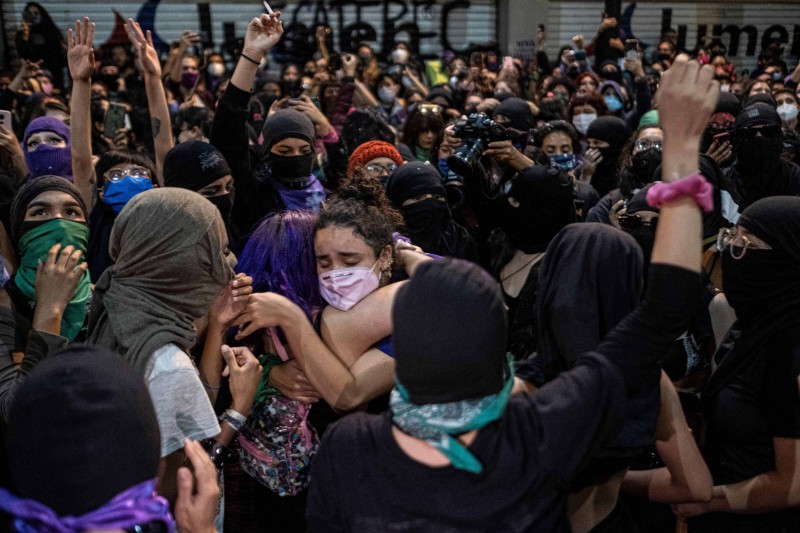
On the International Day for the Elimination of Violence Against Women, human rights groups called on Mexican officials to ramp up efforts to tackle the disappearance of thousands of women, especially those lured into trafficking networks, and to end the impunity shielding those responsible.
A report released Monday reveals that over the past six years, 11,566 women and girls have vanished in the State of Mexico, the region surrounding the capital. Titled “Who searches for us? Who Cares About Us?” the study was compiled by the International Federation for Human Rights (FIDH), along with partners Strategic Human Rights Litigation (IDHEAS) and the Mexican Team of Forensic Anthropologists (EMAF). It highlights how deep-rooted criminal networks, colluding with authorities, have denied families of trafficking victims any real chance at justice.
Many victims are moved to other parts of Mexico or across the border into the United States, where they face sexual exploitation and are sometimes traded between cartels. A pervasive culture of impunity means these cases rarely lead to investigations or prosecutions. In 2021, for instance, only 2 to 6 percent of all disappearance cases nationwide were prosecuted.
“Systemic corruption,” the report notes, allows state officials—often bribed or directly involved in trafficking—to enable criminal networks to operate freely while victims are routinely ignored. This leaves relatives, particularly mothers, to bear the burden of costly, dangerous, and lonely searches. “In a corrupt system, families are the only ones seeking the truth,” said Jimena Reyes, Director of FIDH’s Americas Office.
But those families who pursue justice face threats, extortion, and even criminalization. One example in the report tells of a young woman who vanished after taking a restaurant job. Her family’s pleas to authorities were dismissed. Her brother, desperate for answers, infiltrated the network to gather evidence but was later arrested on suspicion of working with organized crime.
The report ties this judicial apathy to patriarchal norms that “trivialize violence against women.” Disappearances are often written off as voluntary, and trafficking victims are seldom identified as such, letting criminal networks slip through the cracks. “These horrors are the product of a violent, machista and sexist patriarchal culture,” said Juan Carlos Gutiérrez, Legal Director of IDHEAS. “Disregard for the dignity of women victims and their suffering is the constant response of the authorities.”
The study calls for sweeping reforms to break the criminal-political ties behind these crimes, urging the government to focus on fighting corruption and organized crime to ensure victims see justice. “Corruption and organized crime have created a perfect storm of impunity,” Gutiérrez added. “Until the authorities tackle these issues head-on, traffickers will continue to act with complete freedom, and families will remain powerless.”