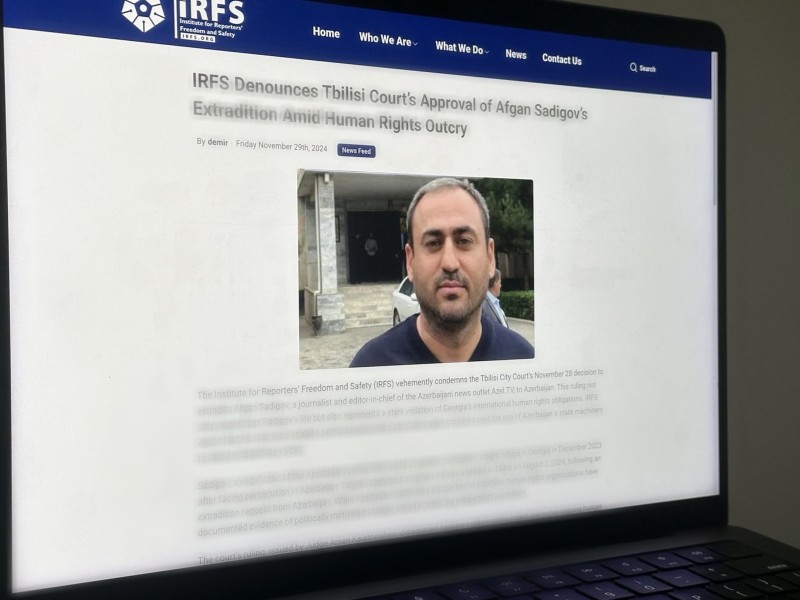
Georgia has forcibly transferred Azerbaijani journalist Afgan Sadigov back to his home country, ignoring an interim order from Europe’s top human rights tribunal that sought to prevent his removal.
Sadigov, who oversees the independent YouTube news outlet Azel TV, sought refuge in Georgia with his family after Azerbaijani authorities intensified their crackdown on independent media and activists in December 2023. His situation took a turn after he posted a critical message on Facebook earlier this month, targeting Georgian law enforcement.
“In any dictatorship, police officers are willing to sell out and abandon principles for a salary and a uniform, carrying out their duties with enthusiasm and pride,” Sadigov wrote in the post.
He was taken into custody on the evening of April 4. Georgian officials later announced his expulsion, stating that a local court found him guilty of insulting police officers. He was fined 2,000 lari ($743) and ordered to stay out of Georgia for three years.
This expulsion marks the end of a protracted legal dispute that crossed borders. In August 2024, Sadigov was arrested in Georgia under extortion accusations from Azerbaijan—claims that he and his backers strongly deny, labeling them politically driven.
A Georgian court had earlier approved his extradition. However, his lawyers appealed to the European Court of Human Rights, which issued an injunction the previous year to block the transfer.
The Georgian Interior Ministry justified the April 5 deportation by saying it had recently learned that Azerbaijani authorities had withdrawn their prosecution of Sadigov on extortion charges. With the extradition request nullified, officials argued the Strasbourg court’s order no longer applied.
Sadigov’s attorney, Mariam Kvelashvili, strongly disputed this reasoning in an interview with Monitori, a partner organization of OCCRP. She said the European court’s interim measure does not simply lapse when local cases end.
“This amounts to a formal workaround of the court’s ruling—and the European court will view this as a violation,” Kvelashvili stated. She stressed that the ECHR must explicitly decide on lifting or canceling its own order.
“Moreover, the interim measure document never states that it is tied to the completion of the extradition case; it explicitly prohibits the transfer itself,” she added.
The expulsion has unsettled the community of exiled dissidents in the Caucasus. After arriving in Baku, Azerbaijan’s capital, Sadigov was briefly allowed to go free, but police quickly detained him again before releasing him, according to a Facebook update from his wife, Sevinj.
“Given these developments, I have strong reasons to be worried,” she wrote.
The Georgian Charter of Journalistic Ethics, a Tbilisi-based group focused on media standards, condemned the government’s actions and expressed support for the expelled journalist.
“Sadigov’s case highlights how effectively authoritarian regimes can work together to target critical journalists, violating human rights and silencing free expression,” the group said in a statement.
The timing of the deportation has also sparked geopolitical questions. Just one day after Sadigov was handed over, Azerbaijani President Ilham Aliyev and First Lady Mehriban Aliyeva arrived in Tbilisi for an official visit.