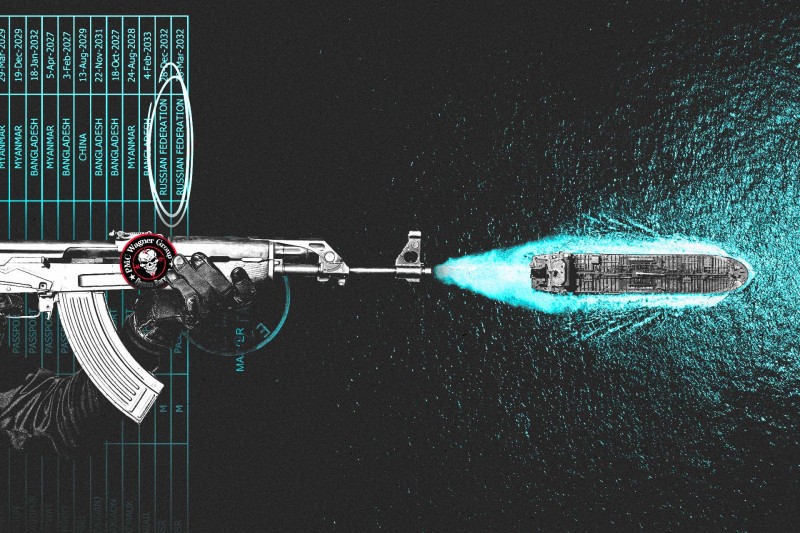
An investigation has revealed a coordinated effort by Russia to place former military personnel, including Wagner Group and GRU veterans, on board oil tankers used to evade Western sanctions. Since July 2025, vessels departing Russian Baltic Sea ports have routinely carried extra crew members with no standard maritime qualifications, according to crew lists analyzed across 20 journeys.
Reports from European media outlets detail the case of the Kira K, a sanctioned tanker that docked at Ust-Luga in December 2025. Officially, the ship carried sailors from Myanmar, China, and Bangladesh, but two Russians—Denis Enin and Aleksandr Kamenev—were listed as “supernumeraries.” Neither held seafarer diplomas, as indicated by “NA” in their records.
Kamenev, 45, and Enin, 48, are Wagner Group veterans. Leaked data shows Kamenev served in Syria and occupied Donetsk, while Enin’s registered address is a military unit in southern Russia. Their placement is part of a broader pattern: of 17 Russian men on these ships without maritime credentials, 13 have ties to Wagner or state security groups like the GRU.
Western intelligence sources say these “vessel protection teams” aim to deter inspections and seizures by Baltic nations. While European authorities cannot stop ships solely for being sanctioned, they have occasionally halted tankers for false flags or cable damage suspicions. Armed veterans on board raise the risk of resistance.
Estonian Colonel Ants Kiviselg noted the goal is to protect Russia’s oil revenue from threats like sabotage. The Baltic route handles about 40% of Russia’s crude exports, generating millions daily for its war effort.
Beyond economic security, analysts argue these teams gather intelligence. Former UK defense attaché Glen Grant said they observe Western responses, building a picture of military capabilities.
Some crew members have been linked to the GRU’s 22nd Spetsnaz Brigade, while others served in Russia’s Defense Ministry or Transnistria’s forces. Ukrainian intelligence reports that private security firms RSB Group and Moran Security Group often hire them. Both companies have faced sanctions.
The deployment comes amid increased Russian naval activity in the Baltic. Estonian Navy Commander Ivo Värk said Russia’s naval presence has quadrupled since 2022, and incidents like airspace violations show Moscow’s readiness to protect its shadow fleet.
European officials admit the presence of armed individuals changes their risk calculus when considering interceptions. A senior intelligence officer stated that Russia believes this makes NATO Baltic states more cautious. Former CIA officer Sean Wiswesser suspects the vessels also serve as platforms for sabotage and intelligence, citing numerous undersea cable cuts in the region.
Despite inquiries, Russian authorities, Lukoil, and the Kira K’s management did not respond. One crewman, Enin, denied being on board, while another, Frolov, threatened to report reporters to the FSB. The findings underscore a systematic militarization of Russia’s shadow fleet, blending economic evasion with potential security threats.