On a Sunday afternoon in late February, the streets of Puebla were filled with color and music as carnival dancers performed for crowds. That festive atmosphere shattered within minutes when news broke that a major drug lord had been killed in a confrontation with federal forces hundreds of miles away.
What followed was a carefully orchestrated campaign of terror that blurred the line between reality and fabrication. The criminal organization once led by the slain kingpin unleashed a wave of chaos across 20 of Mexico’s 31 states, using a mix of genuine violence and digital deception that left the nation paralyzed with fear.
Authorities later confirmed that 42 cartel members and 25 National Guard soldiers died in the coordinated attacks. Yet for all the destruction, only one civilian was reported killed—a pregnant woman caught in crossfire in the city of Zapopan.
The true damage was psychological.
Within hours of the initial reports, social media platforms became battlegrounds. Images of burning vehicles, a passenger plane engulfed in flames on a runway, and a church set ablaze in Puerto Vallarta circulated widely. Fact-checkers later determined many of these images were fake, some generated by artificial intelligence tools like Google Gemini.
In Puebla, a rumor about a shooting and a burning truck sparked panic. Dancers abandoned their performances, and families fled to their homes. The carnival was canceled. But the alleged shooting was a false alarm.
Specialists tracking online propaganda traced the false images to just three accounts on X, which they believe are linked to the cartel. These accounts understand how to manipulate social media algorithms to maximize reach and create the illusion of widespread collapse.
“They know how to game the system,” said one journalist who studies disinformation. “It was amplified to appear as though the whole country was on fire, and the truth is that it wasn’t.”
This hybrid warfare strategy—combining real-world violence with digital manipulation—has evolved over two decades. Two decades ago, criminal groups communicated through banners hung on overpasses. Now they inject fear directly into phones, bypassing traditional media entirely.
The government’s slow and confusing response left a vacuum that disinformation quickly filled. While the security ministry posted that commercial centers were unaffected, malls were announcing closures. In one state, officials falsely claimed schools were shut due to strong winds rather than security threats.
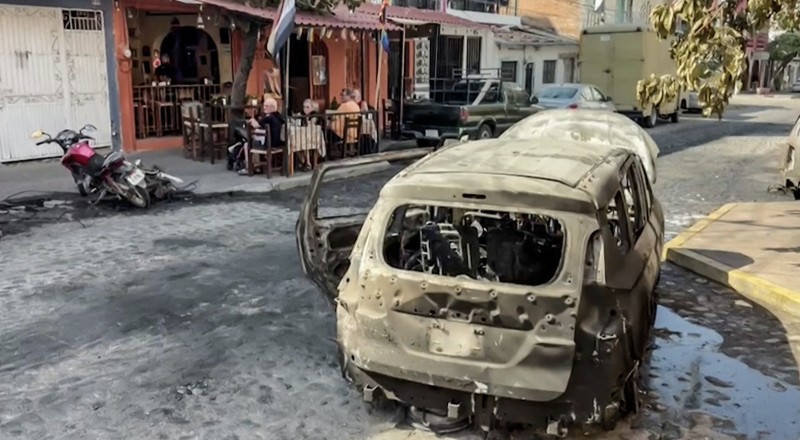
The tactic of burning vehicles to block roads, known as “narcobloqueos,” was pioneered by another cartel years ago but has been refined into a tool of mass psychological warfare. On that Sunday, 252 such blockades were erected across the country—a number far exceeding anything seen before.
Experts say these blockades serve multiple purposes. They disrupt security forces’ ability to respond, create visible chaos that spreads on social media, and generate collective fear among citizens who see their daily routes blocked by flames.
The cartel’s response echoed a 2019 incident when a rival group used similar tactics—including real and fake videos—to force the government to release the son of its imprisoned leader. That event became a template for how criminal organizations can leverage public fear to pressure authorities.
But this time, with the leader already dead, the violence appeared more like a public relations campaign than a tactical operation. The goal was not to free someone but to send a message: even without their kingpin, the organization remains powerful and willing to spread chaos.
Analysts warn that the immediate aftermath may not be the worst. The real danger could come in the following months, as rival groups fight for territory in areas previously controlled by the fallen leader’s organization.
For now, the carnival dancers of Puebla have returned home, but the fear lingers. As one witness described it, “We went into a sort of psychosis.” The cartel’s message had been delivered, amplified, and felt across the entire country.