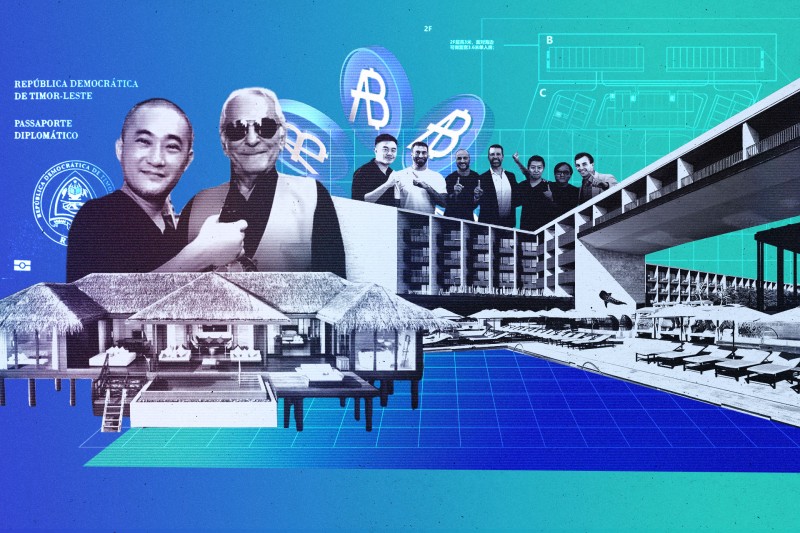
A little-known blockchain network called AB, which recently secured a partnership with the Trump family’s cryptocurrency venture, had been pursuing a luxury resort development in Timor-Leste that involved three people later sanctioned by U.S. authorities for alleged ties to a major online scam operation.
The planned 300,000-square-meter complex near Dili’s airport was promoted as a gathering place for cryptocurrency innovators, with overwater villas, a yacht club, and a “Sea Plaza.” The project was canceled last November, well before reaching any significant development stage.
Investigative reporting has revealed that three individuals connected to the resort were among those penalized by the U.S. Treasury in October during a crackdown on the Prince Group, a Cambodia-based conglomerate accused of running one of the world’s largest online fraud networks. The Treasury previously seized $15 billion in bitcoin from the group’s CEO.
The sanctioned individuals included Yang Jian, a Cyprus citizen who was the majority shareholder of the local company established for the resort. Two others, Yang Yanming and Shih Ting-yu, also worked on the project before being removed shortly after the sanctions were announced.
The resort plan emerged from a memorandum of understanding signed last June between AB’s Irish nonprofit foundation, a Cayman Islands entity, and a newly formed Timorese company. The nonprofit counts two dozen current and former world leaders as advisers, including former Serbian President Boris Tadić and former Irish Prime Minister Bertie Ahern.
Two ethnic Chinese businessmen, Sui Chenggang and Lin Xiaofan, emerged as key figures behind the project, though neither appeared in AB’s public materials. Sui described himself as the “initiator of the AB ecosystem” and beneficial owner of the Cayman Islands foundation. Lin confirmed he played a leading role in the resort development and facilitated introductions to influential figures, including Timor-Leste’s President Jose Ramos-Horta.
Lin traveled to Timor-Leste with actress Fan Bingbing and met with Ramos-Horta, who later recommended Lin receive a diplomatic passport and serve as a special adviser for economic affairs. The president said he accepted an invitation to join AB’s nonprofit as an adviser, believing the blockchain project would bring legitimate investment to the impoverished nation.
Ramos-Horta described Lin as “too secretive” but well-connected, adding that he gained no personal benefit from the arrangement.
AB has publicly touted its collaboration with World Liberty Financial, a cryptocurrency firm co-owned by the Trump family. Sui met with Donald Trump Jr. and Zach Witkoff at a Singapore conference in October, shortly before the partnership was announced in November. Since then, only about $3 million worth of World Liberty’s stablecoin has been held on AB’s blockchain, which Sui attributed to ongoing testing.
World Liberty’s lawyers said the company conducted due diligence on AB and was unaware of the resort project or the sanctioned individuals involved. They called claims linking the company to sanctioned people “unfounded and untrue.”
Lin denied any connection to the Prince Group, stating he has always despised those who operate scam compounds. He acknowledged knowing Hu Xiaowei, an alleged Prince Group affiliate, but described their encounters as coincidental, including a private jet flight from Manila to Switzerland.
The AB network recently clarified its structure, describing itself as a decentralized ecosystem with two real-world companies and two virtual entities. Its Irish nonprofit has made donations linked to China’s “united front” organizations, which analysts say signals alignment with Beijing’s priorities, though Lin dismissed such characterizations as speculation.