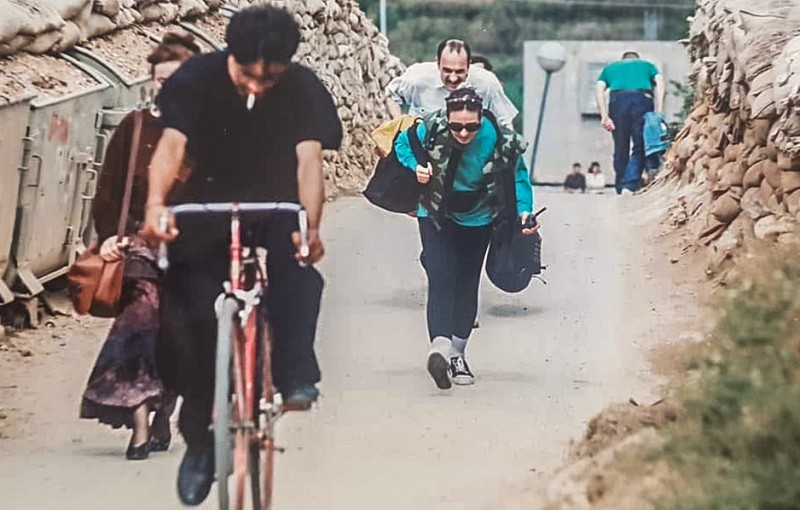
A veteran journalist who covered the brutal siege of Sarajevo believed she had emerged unscathed. But three decades on, the horrors she witnessed have come flooding back, triggered by a single, heartbreaking image.
My name is Aida Cerkez, and today I received a diagnosis of acute stress reaction to war—decades after I reported on the siege for the Associated Press.
While the World Health Organization notes that roughly 70 percent of Sarajevo’s residents suffer from PTSD stemming from the 1992-1995 conflict following Yugoslavia’s collapse, I left that war zone feeling untouched, carrying no visible emotional scars.
That changed abruptly in August. I watched a video of a four-year-old Gazan boy named Abdullah, sobbing on camera. “Ana jeyaan, ana jeyaan!” he cried. “I’m hungry, I’m hungry!”
Malnourished and frail, Abdullah was evacuated to Turkey. Medical teams fought desperately to save him, but by the time he arrived, his body was a hollow shell—a sad face, a swollen stomach, and limbs like tiny twigs.
He passed away on August 19. That was the last night I slept without medication or for more than two hours. Abdullah was with us briefly, and then we failed him.
As darkness falls, I scroll through channels, hunting for comedies or thrillers, planning what will occupy my hours until morning.
But between every scene, I still hear those words: “Ana jeyaan.”
Then the memories surge: the bombs, the bullets, the faces of lost friends. The image of my boyfriend’s crushed body in the morgue. The feel of someone’s brain tangled in my hair after a blast. The frantic cries for help from wounded people lying in the street—while we cowered behind walls, knowing that the snipers were baiting us to move, waiting to fire again.
I hear the crackle of my Motorola: trlilit.
“Bounty,” my codename. Colleagues worried about me.
“Return to base when possible. Over.”
The blood on my shoes. The brain in my hair. Carefully scraping it into a handkerchief and burying it, with respect, in the backyard. It belonged to someone.
For more than 30 years, none of this haunted me. But it all came crashing back this August.
“Ana jeyaan, ana jeyaan, ana jeyaan”—throughout the night.
I imagined feeding Abdullah, then stroked my pillow, pretending he was falling asleep with a full stomach. I apologized to him endlessly. It offered no relief.
Then came another assignment: a story about a journalist in Gaza and his family’s suffering. My editor asked if I could work on it. I read it. I became sick. I wept. My mother insisted I see a doctor. The family physician sent me directly to a psychiatrist.
After several tissues came the standard questions:
“Are you considering suicide?”
“Do you feel the urge to harm yourself?”
But when I confessed that I had cried over not finding a parking spot, and that two days earlier I had broken down because the supermarket was out of peanut butter, she stopped me.
“Turn off your TV, your phone, your computer immediately. These pills will help you sleep. You must rest!”
In the diagnosis field, she wrote F43.2, followed by two medications and instructions: nature walks, rest. “See you in three weeks.”
F43.2 is the code for acute stress reaction, a form of PTSD. But I don’t need a code. I know the real name of my illness: war. It never truly leaves you, even when you think you’ve left it behind.
But I will recover. I will return, refreshed and resolute, to report on the world’s injustices. I am a journalist—that is how I make sense of existence. And I will continue reporting on Gaza.
I want Abdullah to remain a haunting presence for the world, forever.