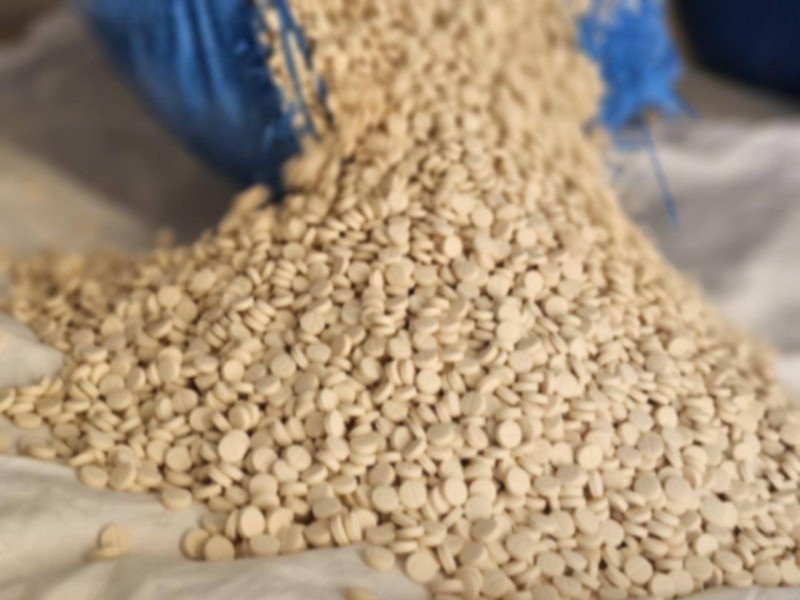
Anti-narcotic forces in Syria intercepted 100,000 Captagon pills at the Jordanian border on Tuesday, just one day after Saudi customs officials seized nearly 1.4 million tablets concealed within a shipment of air conditioning units, according to official statements from both nations.
Captagon, a stimulant drug widely abused across the Middle East, continues to be produced on a massive scale in Syria, which is regarded as the region’s dominant manufacturer despite the recent political shifts.
The Syrian Interior Ministry offered scant details on the Tuesday seizure, noting only that standard legal proceedings would follow. Meanwhile, Saudi authorities reported that the larger cache was discovered at the Al Batha crossing, destined for entry from the United Arab Emirates.
Originally developed in West Germany during the 1960s as a treatment for conditions like attention deficit disorder and depression, fenethylline—marketed as Captagon—was outlawed in most countries by 1986. Counterfeit versions have since become a favored recreational substance in Gulf nations, including Saudi Arabia, the UAE, and Qatar, and were even used by combatants during Syria’s civil war. Today, these illicit pills often stray from the original recipe, containing substitutes like caffeine, theophylline, or paracetamol.
Over the last decade, Syria’s civil conflict crippled its legitimate economy, transforming the country into a narco-state under the former Assad administration and making it the world’s foremost Captagon supplier. Large shipments have been intercepted at ports in Libya, Italy, Greece, and Romania, many originating from Latakia, Syria’s Mediterranean hub. The most notable of these, seized in June 2020 near Naples, contained over 14 tons of Captagon valued at roughly €1 billion.
Before the Assad regime’s collapse, investigative reports linked family members of the ousted president to a ship holding over $100 million in hashish and Captagon—Greece’s largest such seizure in decades. Following the regime’s fall, evidence of state involvement emerged as manufacturing equipment and pills were uncovered in military facilities across Syria.
“The Assad regime has been using drugs as a weapon against its neighbors,” noted Joel Rayburn, a former U.S. special envoy to Syria, in a 2023 interview.
While Syria’s current transitional government has pledged to curb Captagon production and smuggling, experts warn the trade is unlikely to disappear. Narcotics became Syria’s most valuable export under the former regime. A recent report from the New Lines Institute for Strategy and Policy argued that the 2024 crackdown and subsequent political changes won’t halt the industry, but will instead complicate monitoring efforts. The Washington-based think tank urged global leaders to provide Syria’s interim government with resources and sector-specific sanctions relief to encourage participation in the legal economy over illicit activities like drug manufacturing.