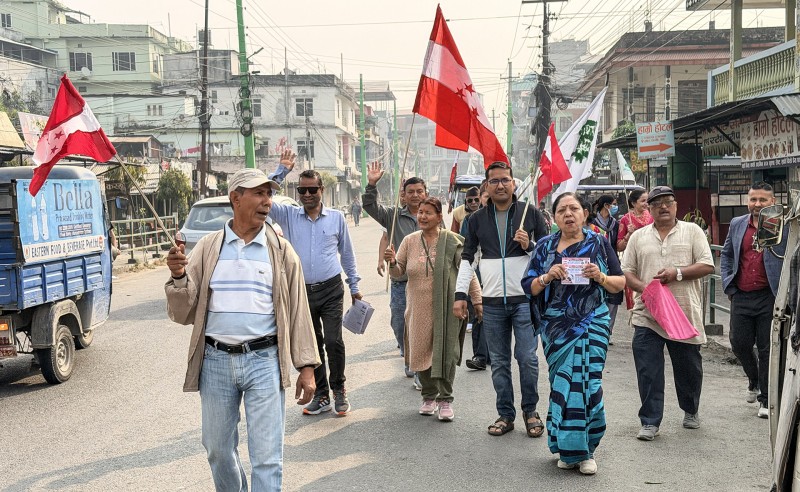
Nepal is set to hold general elections on March 5, six months after youth-led protests forced the previous government out of power. Now, the same political parties that were the target of public anger are campaigning on a shared platform: ending corruption.
Their proposals include sweeping asset checks on top officials, using artificial intelligence to flag graft, and even a call to bring back the death penalty for serious crimes—despite Nepal abolishing capital punishment in 1990.
But many of the young people who sparked last year’s uprising remain deeply skeptical. Rakesh Kumar Mahato, a 25-year-old protester left paralyzed by a bullet to the spine, voiced the common doubt: “They promise to investigate corruption, but we can’t be sure they’ll actually follow through.”
Since September, an interim government led by former Chief Justice Sushila Karki has been in place. She moved the election forward by nearly two years in response to the Gen Z movement.
Around 915,000 first-time voters are among the 8.9 million eligible to cast ballots for the 275-seat House of Representatives. Yet young people remain largely absent from the candidate list—only 5.6 percent of those running are under 30.
The Election Commission has introduced stricter rules this year. All campaign spending must go through dedicated bank accounts, donations above 25,000 rupees (about $172) require direct deposit, and larger donors must provide tax identification numbers.
A recent investigation by the Nepal Investigative Multimedia Journalism Network found that political parties had dodged taxes, submitted fake financial statements, and repeatedly broke donation disclosure laws. However, a pre-election review by the Asian Network for Free and Fair Elections warned that the new rules suffer from “weak enforcement and minimal deterrence,” leaving vote-buying and patronage unchecked.
Human rights defenders echoed those concerns. “Internal transparency is missing,” said Murari Prasad Kharel of the National Human Rights Commission. “Will leaders reveal their own assets? How will internal party governance work?”
Critics also point to a lack of concrete plans. “Setting up a commission isn’t enough if there’s no strategy for implementation,” said former Acting Auditor General Shukdev Bhattarai Khatri. “We’ve seen two dozen commissions in 70 years—their reports gather dust.”
That frustration fueled the protests that left over 2,000 injured and 77 dead, with security forces firing on crowds and demonstrators torching buildings including the Supreme Court and parliament.
As election day nears, tensions remain high. Interim Premier Karki has ordered heightened security after reports of clashes between rival party supporters.
The most closely watched race is in Jhapa 5, where former Prime Minister KP Sharma Oli—forced to step down during the uprising—faces rapper-turned-politician Balendra Shah. Shah, a former Kathmandu mayor, joined the Rastriya Swatantra Party to take on the old guard on their home turf. While no official polls exist, his party is widely seen as the frontrunner.
Shah’s election pledge promises to “raise strong voices against irregularities and corruption.” Oli’s letter vows that if his Communist Party of Nepal returns to power, “Zero tolerance will be adopted in curbing corruption,” adding that his previous government had made some progress.