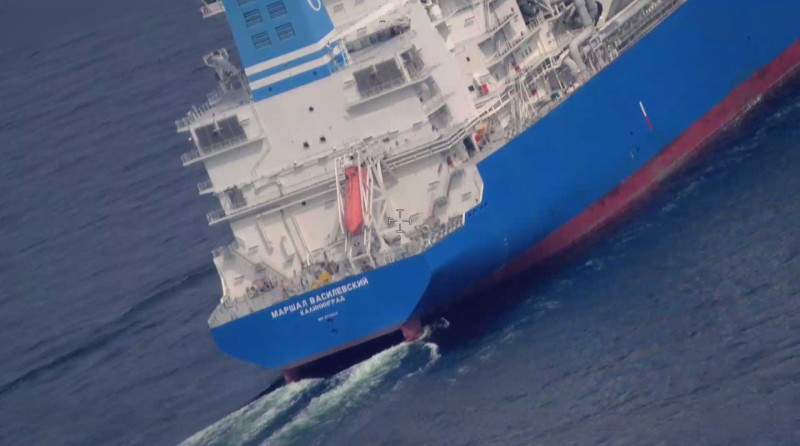
New surveillance images have exposed that Moscow has outfitted a civilian tanker delivering liquefied natural gas to its Kaliningrad exclave with heavy weaponry, marking a significant escalation in maritime tensions in the region.
The ship, the Marshal Vasilevskiy, was photographed in mid-May with sandbagged firing positions and 12.7 mm Kord machine guns mounted on both sides of its bridge. These weapons, capable of striking targets up to two kilometers away, represent a notable departure from the vessel’s original civilian role. Operated by the state-owned energy giant Gazprom, the tanker transports LNG from the mainland port of Bolshoy Bor to Kaliningrad, located between Lithuania and Poland.
Experts examining the photographs noted that the defensive fortifications are manned by individuals who appear to have military backgrounds. Passenger manifests obtained by investigators show that since August 2025, the tanker has carried 50 individuals listed as “passengers,” 22 of whom have proven ties to Russian military or intelligence structures, including the FSB. Among them is Dmitry Artenko, who registered an address at an FSB facility near Moscow and has been aboard for the vessel’s last four trips, including the journey photographed by Estonian border guards.
Defense analysts say the move is likely intended to deter potential Ukrainian sea drone attacks or to send a broader message to NATO countries. “This is part of putting pressure on NATO countries,” said Patrick Bolder, a defense expert from The Hague. A senior intelligence official from a Baltic state suggested the guns may be partly symbolic: half aimed at repelling a possible strike, half at signaling Russia’s readiness to defend its assets. Another European intelligence source noted that the vessel’s role in keeping Kaliningrad supplied is “very important” to Moscow.
The ship is not part of the so-called “shadow fleet” of aging tankers that evade sanctions; it sails between two Russian ports and is not currently subject to international restrictions. However, intelligence officials warn that the arming of this vessel could set a precedent for other ships in Russia’s fleet. “If the rumor gets going that the shadow fleet has heavy machine guns on board, the threat assessment of boarding is completely different,” one official said.
Estonian naval commander Commodore Ivo Värk stated that if the tanker opened fire on another nation’s vessel, Estonian defense forces would be compelled to respond. Veiko Kommusaar, deputy director general of Estonia’s border guard, emphasized that any Russian-operated ship in the Baltic Sea, regardless of its flag, poses both security and environmental risks.
Gazprom did not respond to requests for comment. The Marshal Vasilevskiy has completed four journeys along the Estonian, Latvian, and Lithuanian coasts since last August, with the most recent trip bringing it within 13 nautical miles of Estonian territory.