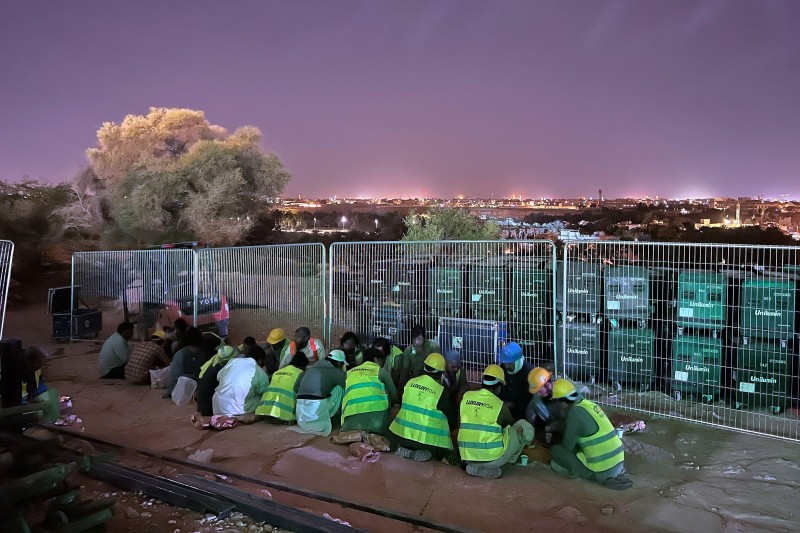
Migrant laborers on Saudi Arabia’s massive infrastructure projects, including those tied to the 2034 FIFA World Cup, are facing life-threatening conditions that have led to deaths from falls, electrocution, and other preventable accidents. With a migrant workforce now exceeding 13 million, human rights organizations are sounding alarms over a system that often fails to properly investigate deaths, leaving families without compensation or answers.
A recent investigation by Human Rights Watch, based on interviews with relatives of 31 deceased workers and eyewitness accounts, revealed that many such fatalities are incorrectly recorded as natural causes. This practice sidesteps thorough probes and denies survivors their due benefits. Another report from the group FairSquare highlighted widespread flaws in the kingdom’s medical and legal systems, noting an “almost complete absence of transparency” in documenting how and why workers die.
“Saudi Arabia presents exceptionally high hazards for migrant workers,” said Nicholas McGeehan, FairSquare’s founding director, during a press briefing on Tuesday. He argued that many of these deaths were avoidable if proper safety protocols and labor protections had been enforced.
The number of migrant laborers in Saudi Arabia surged by 40 percent from 2019 to 2024, driven by the demand for labor on mega-projects such as 11 new stadiums, 73 training facilities, and expanded transit networks for the World Cup. As construction intensifies, risks are growing, according to HRW. The group also pointed out that autopsies are seldom performed when the cause of death isn’t clear, leaving gaps in accountability.
Rights advocates accused FIFA, football’s global governing body, of disregarding its own human rights commitments when it awarded the 2034 tournament to Saudi Arabia without insisting on rigorous worker protections, including safeguards against extreme heat and mandatory life insurance. McGeehan called FIFA’s risk evaluation “amateurish and negligent,” criticizing President Gianni Infantino’s recent presence alongside a U.S. delegation in Saudi Arabia as a sign of deeper issues.
“FIFA has evolved from a simply dysfunctional organization into one that is sinister and dangerously influential in global politics,” McGeehan stated.
Michael Page, deputy Middle East director at HRW, emphasized that these workplace tragedies should serve as a critical warning for businesses and sports entities collaborating with FIFA on the 2034 event. He noted that in March, a Pakistani worker named Muhammad Arshad died after falling from a high level at Aramco Stadium, marking the first reported fatality on a World Cup construction site, just three months after the country was named host.
The consequences ripple far beyond individual incidents, said HRW. Families often lose their primary income, forcing children into labor. One widow of a Bangladeshi worker shared, “I’ve had to send my 14-year-old son to work just to cover our daily needs.” Many families also face exorbitant costs for repatriation or burial, with some reporting offers of financial incentives to bury loved ones locally, followed by compensation withdrawals if they refused.
In response, FIFA announced plans to establish a worker welfare system in Saudi Arabia with mandatory standards and enforcement for World Cup-related projects, but failed to specify concrete steps for preventing deaths, conducting investigations, or ensuring compensation.