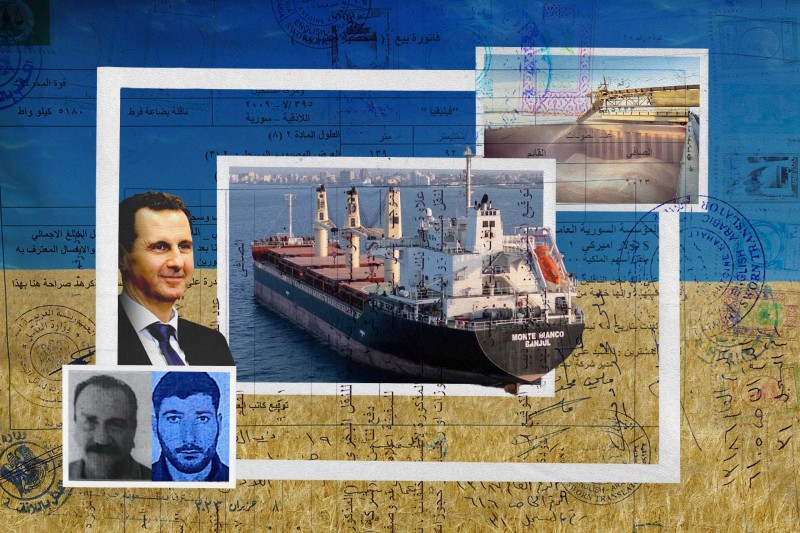
Three cargo vessels accused of transporting grain looted from Russian-occupied Ukrainian ports have been traced back to an offshore company controlled by an individual with close ties to the former Assad government, newly obtained documents reveal.
The ships—originally named Finikia, Laodicea, and Souria—were once state-owned assets of Syria. In 2023, they were quietly sold to a Seychelles-based firm called AlHouda Holding. According to sales contracts reviewed by journalists, two of the vessels were transferred for the symbolic price of just one dollar each, a red flag that experts say signals an effort to move assets off the state’s books while maintaining covert control.
“Selling multimillion-dollar ships for a single dollar strongly suggests a related-party deal designed to keep these assets within the regime’s sphere of influence,” said a sanctions analyst specializing in Syria’s economy. The analyst described the transaction as a textbook example of how public property was funneled into offshore shells linked to the former dictator’s inner circle.
The director of AlHouda Holding at the time of the sale, Ali Mohamed Deeb, has been identified as a shareholder in multiple companies that faced Western sanctions. One such firm, Iloma Investment, was described by the European Union as a front for the Assad family. Deeb also held stakes in businesses whose partners were sanctioned for supporting the former regime.
Since their sale, the three vessels have operated under a cloud of secrecy. They have changed names multiple times, falsely registered under different flags, and routinely disabled their location-tracking systems—behavior typical of ships trying to evade international sanctions.
Ukrainian authorities have accused all three vessels of being part of a fleet that helped Russia expropriate an estimated 15 million tons of Ukrainian grain since the invasion began. Satellite imagery and ship-tracking data pieced together by reporters show the ships traveling between Russian-controlled Black Sea ports, Syria, and other destinations.
Further investigation revealed connections between the ships and Taher Kayali, a Syrian businessman under U.S., U.K., and EU sanctions for alleged involvement in captagon trafficking, an illicit drug trade that reportedly provided financial support to the Assad regime. Companies linked to Kayali have been involved in managing the vessels, and in one case, one of the ships was transferred to a UAE-based firm with ties to his network.
The Syrian transitional government has established a commission to investigate stolen funds, but little transparency has emerged regarding efforts to recover assets allegedly amassed by the former regime.