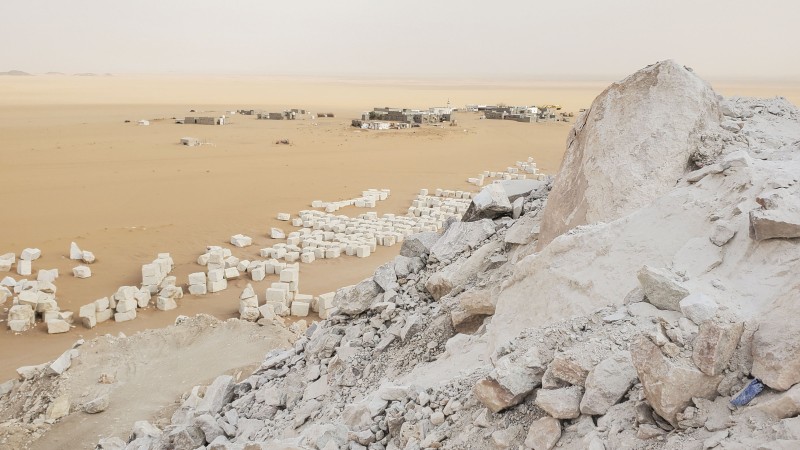
In the rugged desert of central Yemen’s Marib province, tribal commanders have transformed the region’s marble quarries into personal fiefdoms, extracting valuable stone with little regard for national laws or government authority.
Abdullah Ahmed Ali Shawdaq, a tribal sheikh and military leader whose forces have fought against Houthi rebels, now oversees extensive marble operations in the Thaniyah mountain range. Surrounded by armed guards and militia members, he commands a workforce that uses heavy machinery to pull massive stone blocks from the earth.
“Everyone has a destiny written for him,” Shawdaq remarked, recalling how his father first identified the marble deposits decades ago. He asserted that anyone with sufficient resources can mine the mountains freely, “without any intervention” from the state.
Legally, that should not be the case. Yemeni law requires government licenses and royalty payments for marble extraction, treating the resource as state property. But more than a decade of civil war has shattered the country’s bureaucracy, leaving the licensing system in ruins and stripping the industry of oversight.
The result is a chaotic, unregulated free-for-all in one of Yemen’s most potentially lucrative sectors.
“Tribal sheikhs consider themselves above the authority,” said Anwar Qasim Saeed, director of minerals for the licensing authority under Yemen’s internationally-recognized government. He confirmed that no official marble excavation licenses have been issued in Marib province since 2014.
Ismail Nasser Al Ganad, a geologist who formerly chaired Yemen’s mineral licensing body, explained the fundamental conflict: “The areas aren’t easy for the state to claim as its own because, in the tribes’ view, ‘this is ours.’ We tell them yes, the mountains are indeed yours, but the resources beneath them also belong to the state.”
Tribal leaders have always been influential in Yemen, but their power has expanded dramatically since the war began, particularly in Marib. Tribes that helped government forces repel Houthi advances have become indispensable allies, and their influence has grown accordingly.
With government oversight evaporating, the mining sector has descended into what researcher Mohammed Ali Thamer describes as “waves of random prospecting, scavenging, looting, and the destruction of mines.”
Shawdaq initially told reporters he operated without a license and had stopped paying state dues after the war began. “We are prepared to pay anything to the state, but it must provide us with fuel, electricity, and essential services,” he said, accusing the government of negligence. Later, he claimed he held a valid license and paid annual fees, though he provided no evidence of either.
Another tribal quarry owner, Ali Abdallah Saleh Ruqaisian, was more direct. “I don’t pay the state anything,” he declared. “We don’t pay and we won’t pay. The state wants the citizen to remain under its boot. After the oil, now they want to take our hard work? No.”
Marble has been a cornerstone of Yemeni construction for centuries. Today, the quarries north of Marib city create jagged white scars across brown mountainsides, with makeshift houses dotting the barren plains below. Workers like Jamal Abdo Abdullah al-Qushaibi earn about 180,000 Yemeni rials monthly—roughly $750—which he says is insufficient for his family of eight.
The war has split Yemen into two competing administrations: the Saudi-backed internationally-recognized government in Aden and the Iran-backed Houthi rebels controlling Sanaa. Corporate registries are divided between them, and their maintenance is minimal.
Tracing ownership or profits has become nearly impossible. Shawdaq’s company, Abdullah Ahmed Bin Shawdaq for Marble & Granite Establishment, appears in commercial registration records but is absent from the official online registry. Documents show the firm sold over 81 tonnes of marble to a Saudi company in February 2025 for approximately $2,300.
The tribal-state alliance in Marib remains fragile. In May 2025, Abida tribesmen ambushed government forces and captured 25 soldiers after authorities intervened in a dispute over a stone quarry.
“When entrepreneurs working in this sector manipulate the system, operating outside the government’s purview, the state suffers substantial losses,” said Ali Mohamed Ali Ghaithan, who runs the only licensed iron mine in Marib.
Before the war, the World Bank estimated that investment in new marble and granite quarries could generate $20 to $30 million in annual sales. That potential remains largely untapped, lost amid conflict, fractured governance, and the raw power of tribal rule.