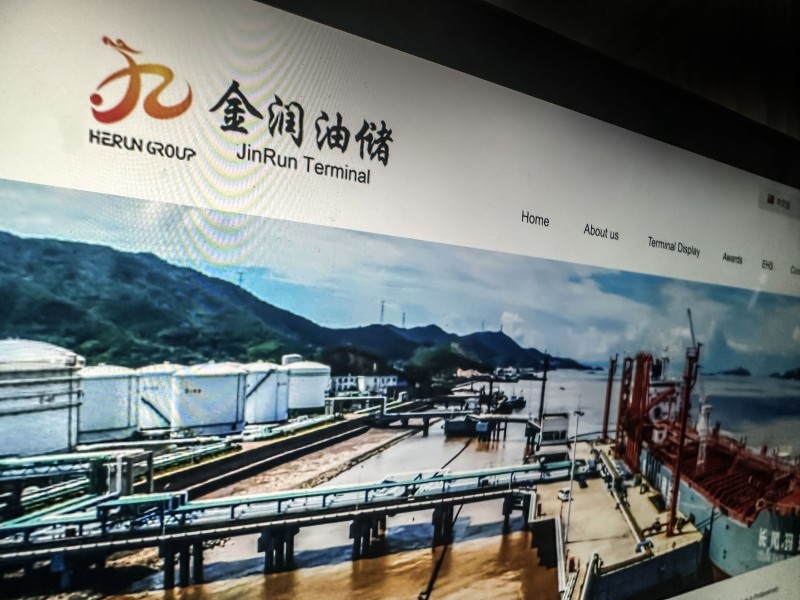
The United States has imposed sanctions on a Chinese oil terminal operator that was a key part of an Iranian sanctions avoidance scheme, a network first revealed by investigative reporters five years ago.
The Treasury Department’s Office of Foreign Assets Control announced the measures against several individuals and companies accused of assisting Iran’s oil industry in funding what Washington describes as militant activities.
Most notable is Zhoushan Jinrun Petroleum Transfer Co., Ltd., a private terminal operator in Zhejiang Province, eastern China. Controlled by the Herun Group, a conglomerate led by Yu Songbo, once among China’s richest executives, the firm was cited for knowingly participating in a major transaction involving the purchase, sale, or transport of Iranian petroleum products.
This company was central to a sanctions evasion scheme uncovered in 2020 by a journalism consortium and a Swedish broadcaster. That probe uncovered a complicated web of financial flows through a Hong Kong shell firm, HMEA Co., Ltd., run by Hatam Khatoun Nema, a Swedish fraud convict with Iraqi citizenship.
Despite reporting registered capital of less than $1,300, HMEA opened accounts at several Hong Kong banks and handled hundreds of millions of dollars in Iran-related deals between 2012 and 2014. This included at least $60 million sent in a single day in July 2013 by China Best International (HK) Ltd., then owned by Liu Qianting, CEO of Zhoushan Jinrun and a top Herun Group official.
Investigators also found that HMEA made large dollar payments to Iranian state oil firms in the Malaysian offshore hub of Labuan during that period. The shell company processed over $130 million in transactions through obscure entities linked to criminal networks connected to a major money-laundering operation, earlier exposed by the same consortium, that funneled billions through Europe and Asia.
Meanwhile, Nema lived modestly on Stockholm’s outskirts, where his home served as HMEA’s official banking address. Besides his role in the Iran-linked scheme, he was convicted in Sweden in 2013 for fraud and tax evasion, tied to generating fake invoices for local construction firms.
He later faced an arrest warrant in Lithuania on charges of money laundering, false accounting, and other crimes related to allegedly forged shipments of Iranian pistachios.
The case illustrates how Iran, under years of U.S. and U.N. sanctions, relied on small-time criminals like Nema and global illicit networks to maintain trade and currency flows.